Peer Review Process

JurisPolitica is committed to maintaining the highest standards of academic integrity and scholarly excellence. To ensure the quality and rigor of the articles we publish, all submitted manuscripts undergo a thorough and impartial external peer review process. This procedure is designed to uphold transparency, fairness, and objectivity, ensuring that each submission is evaluated on its merit, originality, and contribution to the fields of law and political sciences.
Double-Blind Peer Review
Upon submission, each manuscript undergoes an initial editorial screening to assess its suitability for publication in JurisPolitica. Manuscripts deemed appropriate are then sent to two independent reviewers for a double-blind peer-review, ensuring that both author and reviewer identities remain fully concealed throughout the process. To maintain anonymity, authors must prepare their manuscripts in a manner that does not reveal their identity.
Selection of Reviewers
Manuscripts are evaluated by experts in the respective fields who possess the requisite knowledge and experience to provide a critical and insightful review. Our editorial team carefully selects reviewers based on their expertise, ensuring a balanced and comprehensive evaluation. We prioritize the appointment of reviewers with a strong track record of research and publication in law, political sciences, and related interdisciplinary fields.
Review Criteria
Reviewers are asked to assess manuscripts based on several key criteria, including:
- Originality and significance of the research question or thesis.
- Depth and clarity of the analysis.
- Methodological soundness and rigor.
- Relevance and contribution to the fields of law and political sciences.
- Quality of writing, structure, and adherence to the journal’s style and submission guidelines.
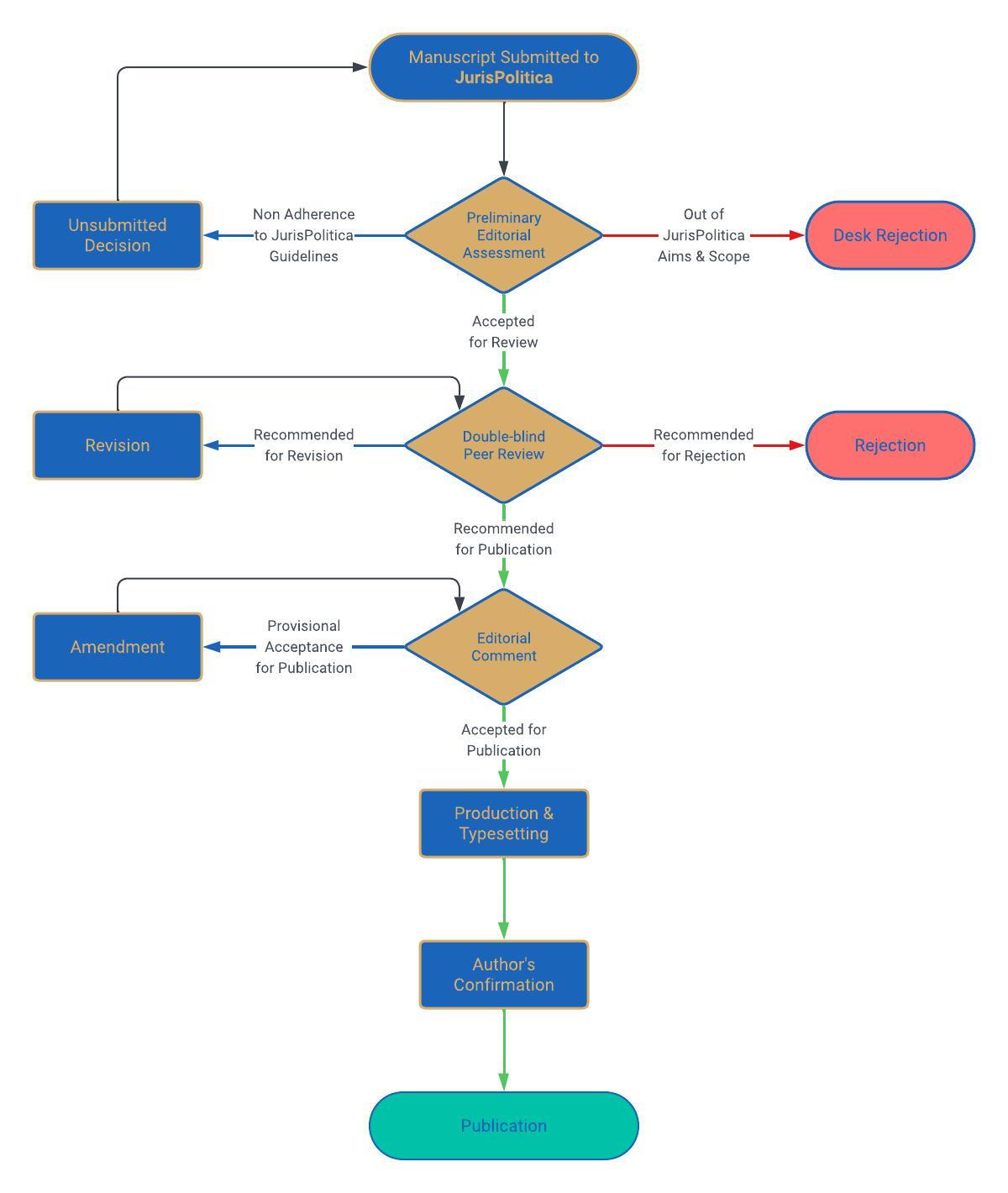
Manuscript Evaluation Process
- Manuscript Submission
- All manuscripts must be formally submitted to JurisPolitica through the journal’s designated submission channel.
- Preliminary Editorial Assessment
- Upon submission, each manuscript undergoes an initial editorial screening conducted by the editorial board.
- This assessment evaluates:
- Compliance with JurisPolitica submission and formatting guidelines;
- Alignment with the journal’s aims and scope.
Possible outcomes of the preliminary assessment:
- Non-adherence to JurisPolitica Guidelines – The manuscript receives an Unsubmitted Decision.
- Manuscript deemed outside JurisPolitica’s Aims & Scope – The manuscript is subject to Desk Rejection.
- Manuscript meets editorial requirements – The manuscript is Accepted for Review and forwarded to the peer-review stage.
- Double-Blind Peer Review
- Manuscripts accepted for review are evaluated under a double-blind peer-review process, ensuring anonymity of both authors and reviewers.
Possible peer-review recommendations:
- Following the reviewers’ evaluations, the editors will decide whether the manuscript should be accepted, revised, or rejected. If both reviews are submitted within the assigned timeframe and their comments are consistent, the editorial decision will be issued accordingly. This process ensures efficiency and minimizes delays that may arise from the review stage.
- Recommended for Revision – The manuscript is returned to the author(s) for Revision.
- Recommended for Rejection – The manuscript receives a formal Rejection decision.
- Recommended for Publication – The manuscript proceeds to the Editorial Comment stage.
- Editorial Comment
- Following favorable peer-review recommendations, the editorial board issues an editorial evaluation.
Possible editorial outcomes:
- Provisional Acceptance for Publication – The manuscript is returned to the author(s) for Amendment.
- Accepted for Publication – The manuscript advances to Production & Typesetting.
- Production and Typesetting
- Accepted manuscripts undergo professional production and typesetting in preparation for publication.
- Author’s Confirmation
- The final formatted version is sent to the author(s) for confirmation and approval prior to release.
- Publication
- Upon author confirmation, the manuscript is formally published in JurisPolitica.
Commitment to Ethical Review Practices
JurisPolitica upholds a commitment to ethical review practices, striving to ensure that all feedback is constructive, respectful, and focused on enhancing the quality of scholarly work. We emphasize the importance of timely reviews and encourage open dialogue between authors and reviewers when needed, while maintaining confidentiality and respect for all parties involved.
This rigorous peer review process ensures that JurisPolitica remains a trusted platform for innovative and impactful research, fostering a vibrant academic discourse in the realms of law and political sciences.
Peer-Review Process Flowchart